Posts

Showing posts with the label thermal management

High-Density Cooling for the AI Era: Adapting Data Centers to 50–100 kW/Rack Workloads

Image
The AI revolution is reshaping data center design — and nowhere is that more evident than in cooling. Modern AI workloads demand unprecedented compute power, pushing server racks into the 50–100 kW per rack range or higher. Traditional air-cooling techniques simply can’t keep up with the explosive thermal loads these systems generate, forcing engineers and operators to rethink how heat is managed at scale. ( Business Wire ) Conventional air cooling — involving raised floors, CRAC units, and hot/cold aisle containment — once handled modest loads of 5–15 kW/rack. But AI clusters packed with GPUs and custom accelerators produce far more heat. Air becomes inefficient as speeds reach limits and energy costs climb, making it increasingly unsustainable for racks beyond 50 kW. ( datacenters.com ) Liquid Cooling Takes the Lead To meet these demands, data centers are rapidly adopting advanced liquid-based cooling strategies that can handle intense heat densities with greater energy efficiency: ...

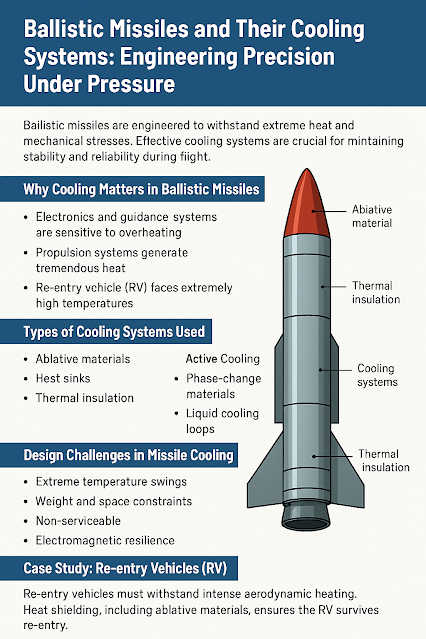
Ballistic Missiles and Their Cooling Systems: Engineering Precision Under Pressure

Image
  Ballistic missiles are among the most complex and critical components of modern defense systems. Designed for high-speed, long-range trajectories, these missiles must endure extreme thermal, mechanical, and atmospheric conditions. A less-discussed but crucial aspect of their operation is the cooling system —a silent guardian ensuring thermal stability, structural integrity, and mission reliability. Why Cooling Matters in Ballistic Missiles While much attention is focused on propulsion, guidance, and warhead technology, thermal management plays a key role in ensuring a ballistic missile performs its mission accurately. Several subsystems require effective cooling: Electronics and guidance systems: Heat-sensitive avionics must operate reliably throughout the flight, particularly in the post-boost and re-entry phases. Propulsion systems: Solid or liquid propellant engines generate tremendous heat, both internally (combustion chamber, nozzles) and externally (aerodynamic ...